
A flat tire is one of the most common roadside problems, and also one of the most manageable, if you know what you are doing and the conditions are right. In Edmonton the conditions are not always right. Winter brings ice, snow and short daylight, and many roads have fast traffic and narrow shoulders. This guide walks you through how to change a flat tire safely, step by step, with tips for cold weather, a list of common mistakes and a clear view of when to stop and call for help instead. It is general advice, so always check your owner’s manual for the details that apply to your car.
First, decide if you should do it at all
The best roadside repair is the one you do not do on a dangerous road. Before you reach for the jack, ask yourself a few questions.
- Is the location safe? A busy highway, a blind curve, a narrow shoulder or a slope is not a place to change a tire. If you are on a freeway such as the Anthony Henday, Whitemud Drive or Yellowhead Trail, it is often safer to stay buckled in with the hazards on and call for help.
- Is the ground firm and level? Ice, deep snow, soft gravel and slopes make a jack unstable. A car that slips off a jack can cause serious injury.
- Is it dark, snowing or extremely cold? Poor visibility and numb fingers increase the risk of mistakes.
- Do you have the right equipment? You need a usable spare, a jack, a wheel wrench and, on some cars, a locking-nut key.
- Are you physically able? Wheels are heavy and lug nuts can be very tight. If you cannot do it safely, do not try.
If any answer is no, call for help. Our flat tire service sends a driver to change the tire on site, or tow the car to a shop if it cannot be fixed.
What you need
Check for these items in your trunk or under the cargo floor before you need them.
- A properly inflated spare tire, either full-size or compact.
- A jack that fits your vehicle.
- A wheel wrench or lug wrench.
- A locking wheel nut key, if your wheels have locking nuts.
- Your owner’s manual, which shows the jacking points.
- Wheel chocks, or a couple of solid blocks.
- A flashlight, ideally a headlamp.
- Gloves, and something to kneel on.
- Reflective triangles or flares.
- A small piece of board to place under the jack on soft ground.
A tire pressure gauge is useful too, because spares lose air over the years.
Step by step: changing the tire
1. Get to a safe spot
As soon as you realise the tire is flat, turn on your hazards and slow down gradually. Do not brake hard or swerve. Look for a flat, firm area well away from traffic, such as a parking lot, a side street or a wide shoulder. Driving a short distance on a flat tire can damage the rim, but it is better than stopping in a dangerous place.
2. Secure the car
Park on level ground, apply the parking brake and turn off the engine. On a manual car, put it in first or reverse; on an automatic, in park. Chock the wheel diagonally opposite the flat, so the car cannot roll. Put out your triangles behind the car, and ask passengers to wait well away from the road, behind a barrier if possible.
3. Take off the wheel cover and loosen the nuts
If your wheel has a cover or hubcap, remove it. Use the wrench to loosen each lug nut about a half turn counter-clockwise, but do not remove them yet. Do this while the tire is still on the ground, because the weight of the car holds the wheel still while you apply force. If a nut is stuck, you can stand on the wrench handle, carefully, or use a longer bar. If you cannot loosen them, stop and call for help.
4. Place the jack correctly
Find the jacking point near the flat tire. Your owner’s manual shows where it is, and it is usually a reinforced spot on the frame behind the front wheel or ahead of the rear wheel. Using the wrong spot can damage the car or cause it to slip. On soft ground, put a firm board under the jack. Raise the car until the flat tire is just off the ground, and no higher than needed. Never put any part of your body under the car, and never start the engine while it is jacked up.
5. Remove the nuts and the flat
Finish unscrewing the lug nuts by hand and keep them together, in a hubcap or your pocket, so they do not roll away. Pull the wheel straight toward you and lay it flat on the ground, so it cannot roll into traffic.
6. Mount the spare
Line up the holes in the spare with the studs, and push it on. Thread the lug nuts on by hand, with the tapered side facing the wheel. Tighten them until they are snug, in a star pattern, not in a circle. This helps the wheel seat evenly.
7. Lower the car and tighten fully
Lower the car until the tire touches the ground but the weight is not all on it, and tighten the nuts firmly in the star pattern. Then lower the car fully, remove the jack and give the nuts a final tightening. If you have a torque wrench and know the right value for your car, use it. Otherwise, ask a shop to check the torque soon after.
8. Pack up and check
Stow the flat tire, jack, wrench and chocks. Check the spare’s pressure as soon as you can. A compact spare usually has a higher recommended pressure than normal tires, and it is marked on the sidewall. Remember that a compact spare is for short trips and low speeds only. Obey the speed limit printed on it.
Winter-specific tips
Changing a tire in an Edmonton winter takes extra care.
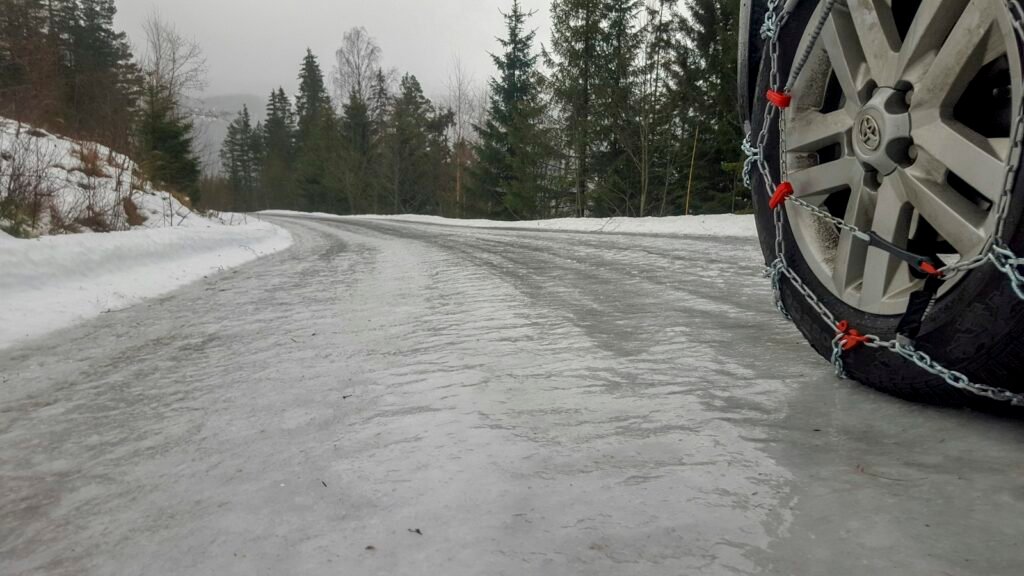
- Do not jack on ice or packed snow. It can slip. Use a board, or move the car to a better spot if you can do so safely.
- Dress for the job. Gloves with grip help, and a warm layer under a hi-vis jacket if you have one. Frozen fingers drop nuts.
- Expect stuck nuts. Cold and road salt can seize lug nuts. Give yourself extra time.
- Keep warm between steps. If you feel numb or are shaking, stop and get back in the car.
- Keep your phone warm. Cold drains batteries quickly. Keep it in an inside pocket.
- Think about visibility. Short winter days mean you may be working in the dark. A headlamp frees both hands.
Common mistakes
- Jacking on a slope or soft ground. This is the biggest cause of injuries.
- Not loosening the nuts first. The wheel spins when the car is in the air.
- Using the wrong jacking point. It can bend body panels or let the car fall.
- Going under the car. Never, with only a jack holding it.
- Over-tightening or under-tightening nuts. Both are dangerous. Tighten in a star pattern and have a shop check them.
- Driving too fast on a compact spare. They are not designed for it.
- Forgetting to repair the flat. A flat that is not fixed leaves you with no spare.
- Ignoring a nail in the sidewall. Sidewall damage cannot be safely repaired.
Run-flat tires, sealant kits and no spare
Many modern cars do not carry a spare. Some have run-flat tires that can be driven for a limited distance at reduced speed after losing air. The manual gives the range and speed. Others have a sealant and inflator kit. Sealant can work on a small puncture in the tread, but it will not fix a sidewall cut or a damaged rim, and it can make a later professional repair more difficult. If your car has no spare and the tire is badly damaged, the safe answer is a tow to a tire shop. We use a flatbed for this, which is especially important for all-wheel-drive cars.
After the change
Within a day or so, have the flat inspected. A shop can tell you whether it can be repaired or whether it needs replacing. Check the spare’s pressure and fix or replace the flat so that you are not without one. If the flat was caused by a pothole, read our guide on what to do after a pothole flat tire, since the hit may have caused damage you cannot see. After a few kilometres on the spare, re-tighten the lug nuts, because they can loosen slightly as the wheel settles.
Prevent the next one
- Check tire pressure monthly and before long trips.
- Inspect tires for cuts, bulges and uneven wear.
- Replace tires that are old or worn.
- Rotate tires on schedule.
- Avoid potholes and debris.
- Make sure the spare and tools are in the car and in working order.
When to call a pro
If the location is unsafe, the weather is bad, the nuts will not budge, the spare is flat or you simply do not feel confident, call Maxim Towing & Recovery at (780) 604-4060. A driver will change the tire safely, or tow the vehicle to a shop. Our typical arrival window is 30 to 45 minutes, though weather and call volume can change that. We accept cash, credit and debit. See our roadside assistance page for the full range of help.
Practise once in your driveway
The worst time to learn how your jack works is on a dark shoulder in January. Spend twenty minutes on a mild weekend practising in your driveway. Find the spare, the jack and the wrench, and see how they come out of their storage spots. Look up the jacking points in your manual and mark them with a small piece of tape if that helps. Loosen one lug nut to feel how much effort it takes, then tighten it again. If the nuts are very tight, a shop can loosen them and re-tighten to the right torque so you are not fighting them at the roadside.
It is also a good time to check the spare. Many people discover that it is flat, or that it has aged and cracked, only when they need it. A spare that is several years old can deteriorate even if it has never touched the road. Check the pressure, look at the sidewalls and replace it if it looks tired. If your car has a locking wheel nut, confirm you know where the key is, because without it you cannot remove the wheel at all.
Teach the people who drive your car
If other people use your car, such as a partner, a teenager or an elderly parent, make sure they know the basics too. They do not need to be mechanics, but they should know where the spare and tools are, how to turn on the hazards, when to stay in the car and how to reach roadside help. Put our number in their phone, and show them how to share their location. A short conversation can make a big difference when someone is alone, upset and unsure what to do.
Reading the tire so you can describe the problem
When you call for help, a clear description saves time. Note whether the tire is completely flat or just low, whether you can see a nail or a cut, and whether the wheel itself looks bent. Tell the dispatcher the tire size if you can read it on the sidewall, which looks like a string of numbers such as 225/65R17, because a shop or driver can then bring the right replacement if needed. If you have a damaged sidewall, say so. It helps the driver decide whether to change the tire on site, or tow the car for a proper repair.
Frequently asked questions
How long does it take to change a flat tire?
With the right tools and good conditions, it often takes 20 to 30 minutes. In winter or on a stuck wheel it can take longer.
Can I drive on a compact spare on the highway?
Only at the speed marked on the spare, usually well below highway speed, and for a short distance to a tire shop.
Should I change a tire on the Henday or Whitemud?
If there is no safe shoulder, it is often safer to stay belted in with hazards on and call for help.
What if I cannot loosen the lug nuts?
Do not force it unsafely. Call a roadside service, which has tools to remove stuck nuts.
Can you change my tire for me?
Yes. Call (780) 604-4060 and a driver will change the tire or tow the car to a shop.
2 Responses